 USA
USA  Canada
  Brazil
  Germany
  France
  Italy
Italy  Switzerland
  Sweden
  Spain
Spain  Norway
  Russia
  South Africa
  Japan
Japan  New Zealand
  Australia
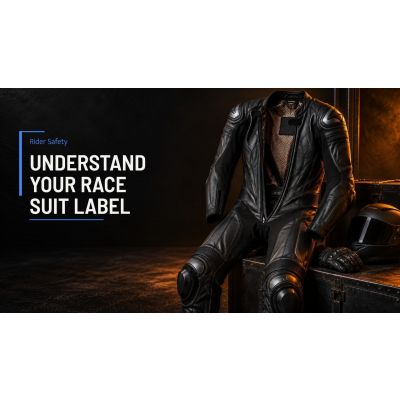
A CE-marked one-piece race suit is a suit whose maker states that it meets the European rules for personal protective equipment, usually through the EN 17092 standard series. The label is a starting point for questions, not an answer on its own: it does not say how a suit fits, which armour sits inside it, or how it was made. This guide explains what the marking means, what the class letters describe, and what to check before ordering a one-piece suit from a or any other maker.
Key Takeaways
- CE marking is a legal statement by the maker under the EU PPE Regulation, not a ranking of quality.
- EN 17092 sorts garments into five classes (AAA, AA, A, B, C), and the class describes the garment, not a riding style.
- Armour is tested separately, for example to EN 1621-1 for limb joint protectors, and comes in Level 1 or Level 2.
- Ask for the standard, class, armour level and documents; a label without them says little.
What CE marking on a race suit actually means
Motorcycle clothing counts as personal protective equipment (PPE) in the European Union. The European Commission explains that the CE marking on PPE is evidence that the product complies with the applicable EU legislation, and that manufacturers must meet the essential health and safety requirements of the PPE Regulation, either directly or by using harmonised European standards (European Commission, PPE overview). Following a harmonised standard gives a presumption of conformity.
The same page notes that only notified bodies may issue certificates proving compliance for this kind of equipment. In practice, this means a rider who sees "CE" on a suit can reasonably ask three follow-up questions: which standard was used, which class or level was assessed, and which document backs it up.
The EN 17092 classes in plain terms
SATRA, a testing and research body, describes EN 17092:2020 as covering jackets, trousers and one- and two-piece suits, sorted into classes AAA, AA, A, B and C. Classes AAA and AA make elbow, shoulder, knee and hip impact protectors mandatory, class A makes hip protectors optional, class B has no mandatory impact protectors, and class C is for garments worn with higher-class clothing (SATRA, EN 17092).
| Class | What it describes |
|---|---|
| AAA and AA | Elbow, shoulder, knee and hip impact protectors mandatory (per SATRA) |
| A | Elbow, shoulder and knee protectors mandatory; hip protectors optional |
| B | No mandatory impact protectors |
| C | Impact protection only for the areas covered; worn with higher-class garments |
These classes should not be read as a shortcut to a riding style. A class is a set of test requirements for a garment; it does not decide whether a suit is appropriate for a given circuit, road or skill level. That choice depends on the full picture, including fit, armour and condition.
How abrasion resistance is tested
The EN 17092 series uses the Darmstadt machine. SATRA describes this test as simulating an average rider (75 kg, 1.75 m) sliding on a concrete road surface, with pass or fail results at set machine speeds. The point for a buyer is that the result belongs to a tested garment construction. Changing the leather, panels or seams of a suit changes what was tested.
Armour is assessed separately
Protectors for knees, elbows, shoulders and hips fall under EN 1621-1. In that standard, Level 1 requires a mean transmitted force below 35 kN with no single result above 50 kN, and Level 2 requires a mean below 20 kN (Wikipedia, motorcycle armour). Lower transmitted force means less force reaches the body in the test. Back protectors fall under EN 1621-2, where Level 2 also allows lower transmitted force than Level 1.
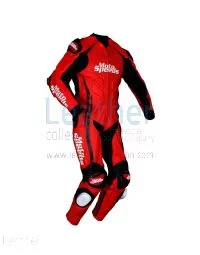
For a one-piece suit this matters because the armour is often an option. A suit from a may offer armour choices, so the armour level is something to confirm rather than assume from the word CE. For example, the product page of the Tyro leather suit lists EN 1621-1 Level 2 armour at the shoulders, elbows, knees and hips, and also shows a Level 2 entry among its add-ons, so what comes with an order is worth confirming with the maker, along with the documentation.
One-piece or two-piece: where the label fits in
Both formats can be assessed to the same standard series, so the label does not choose between them. A one-piece suit has no waist join and is the format most associated with circuit racing, while a offers more flexibility for getting on and off and for different jacket and trouser sizes. The decision on format rests on fit, comfort and how the suit will be used, with the standards and armour questions applied equally to both.
A checklist for reading the label
- Standard. Look for EN 17092 and a class letter. If an older standard is named, ask whether the garment has been assessed to the current series.
- Class. Compare the class with the paperwork, not with marketing text.
- Armour. Find the armour standard and Level 1 or Level 2 for each zone, and whether a back protector is included or optional.
- Documents. Ask for the declaration or certificate, and check that it refers to the same model.
- Fit. A suit that does not fit keeps armour out of position, whatever the label says. Use the maker's size chart and, for a made-to-measure order, accurate measurements.
Racing-inspired suits and label claims
Many riders look at a or a design inspired by a racing livery for its look first. Styling and protection are separate questions. A design inspired by a rider or team says nothing about standards, so apply the same checklist to every suit regardless of its graphics. Men's sizing and cuts can be browsed in the category, but the label questions stay the same.
What a label cannot tell you
A CE marking or class letter says nothing about how a suit was stored, whether it has been in a crash, or how much the leather has aged. Clothing that has been through a slide may have lost protection even if it looks intact, and the maker's guidance on replacement applies. The tests describe laboratory conditions, not every real crash. Treat the label as one piece of evidence next to fit, armour, construction and the rest of the gear, including gloves, boots and a back protector.
Frequently Asked Questions
Is a CE-rated one-piece race suit the same as an EN 17092 suit?
Not automatically. CE marking shows that a product is declared to meet the EU PPE Regulation, and for motorcycle clothing the relevant harmonised standard is the EN 17092 series. Older garments may refer to earlier standards. Read the label and the documentation to see which standard and which class the maker states, and ask for the paperwork if it is missing.
What do the classes AAA, AA, A, B and C mean?
EN 17092 has five garment classes. According to SATRA, classes AAA and AA require elbow, shoulder, knee and hip impact protectors, class A requires elbow, shoulder and knee protectors with hip optional, class B has no mandatory impact protectors, and class C covers garments worn with higher-class clothing. The class alone does not tell you which riding style a suit suits.
Does the armour level on the label cover the whole suit?
No. Armour such as knee, elbow or shoulder protectors is assessed to its own standard, for example EN 1621-1 for limb joint protectors, and is separate from the abrasion and seam testing of the garment. A suit can accept armour of different levels, so check which armour the product page lists for your suit.
Can a made-to-measure suit still carry a CE marking?
That depends on the maker and the documentation, not on the label wording. Ask what standard the suit is declared to, which class, and for which armour, and ask to see the supporting documents. A claim that cannot be documented should not influence your decision.
Written by the Leather Collection Editorial Team.