
 USA
USA  Canada
  Brazil
  Germany
  France
  Italy
Italy  Switzerland
  Sweden
  Spain
Spain  Norway
  Russia
  South Africa
  Japan
Japan  New Zealand
  Australia
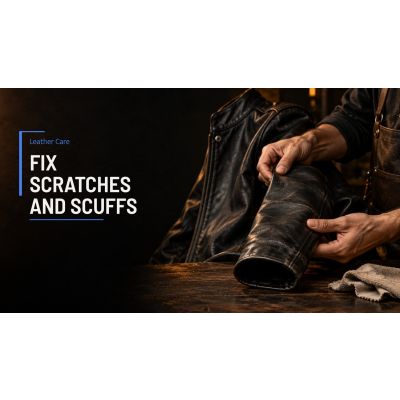
Fixing scratches and scuffs on leather clothing starts with one question: is the mark in the surface finish, or has it cut into the leather itself? A light scuff often looks much better after a gentle, dry clean, while a deep gouge, a torn edge or a scratch through the colour calls for a more careful repair. This guide explains how to tell the difference, what is reasonable to try at home and when to stop.
Key Takeaways
- Identify the damage first: a surface scuff, a scratch through the finish and a cut in the leather need different responses.
- Clean gently and test any product on a hidden area before touching a visible panel.
- Follow the garment's care label and the maker's instructions; the right product depends on the finish and construction.
- Deep scratches, tears and marks across seams are better judged by a leather repairer.
Read the Damage Before Touching It
Good light and a close look save most repairs. Run a fingertip across the mark. If it feels smooth and the leather colour looks the same underneath, the damage is probably limited to the surface finish or a layer of dust and scuffed colour. If the edge of the mark catches your fingertip, the leather fibres may be raised or cut. If a lighter patch shows through, the dye or pigment has been abraded away.
The finish matters as much as the mark. Wikipedia's entry on aniline leather explains that it is dyed without a uniform pigmented topcoat, so natural surface features such as pores and scars stay visible, and that semi-aniline leather has a thin protective top coat. Marks on an unfinished surface like that may therefore show more. The finish on varies from piece to piece, and a coated finish, an oiled or waxed pull-up finish and a suede or nubuck panel all behave differently, so identify the finish before choosing a method.
Clean First, Gently
Many marks that look like scratches are scuffs of transferred dirt or colour from a bag strap, a seat or another garment. Wipe the area with a clean, dry, soft cloth, working with light pressure in one direction. The Canadian Conservation Institute's note on caring for alum, vegetable and mineral-tanned leather, written for museum objects, recommends brushing dust away gently and using light pressure on fine, delicate skins. It is not guidance for worn clothing, but vigorous rubbing can do more harm than the original mark.
If the mark remains, check the care label for approved cleaning methods. Do not soak the leather or use household solvents to see what happens. A product that suits one finish can stain or dull another.
Treating Light Scuffs on Finished Leather
For a shallow scuff on a coated surface, follow the care label. If a leather repairer or the maker recommends a method for this finish, such as a conditioner or a colour-matched product, apply a small amount to a hidden spot, such as the inside of a hem, and let it dry before judging. Colour appears different wet and dry. Repeated rubbing can wear the finish, so stop if colour transfers or the surface feels sticky.
Deeper Scratches and Colour Loss
When colour has been scraped off or the scratch has raised the fibres, home treatment becomes riskier. The Canadian Conservation Institute's note explains that oils and waxes can stiffen leather over time, darken surfaces, stain adjacent materials and attract dust or insects, again in the context of museum collections. A worn jacket has different priorities, but the caution is a reminder that more product is not automatically better.
For deeper marks, the safer route is a repair product designed for your garment's leather type, used strictly according to the maker's instructions. A repair may make a mark less visible rather than make it vanish, and there can be a slight difference in sheen afterwards.
Suede and Nubuck Need a Different Approach
Suede and nubuck are napped finishes that react differently to creams and oils. Follow the care label and the maker's instructions, and ask a specialist before using any product.
Where Scratches Happen on Different Garments
Location tells you what may have caused the damage and how to prevent it. Elbows, shoulders and hips can collect scuffs on jackets, for example where a bag strap or a bike seat rubs. Seat edges, zips and rivets can mark the thighs of , and women's and skirts can show marks where bag buckles and belts press against them.
The table below is general guidance, not taken from a cited source.
| Type of mark | Possible cause | Sensible first step |
|---|---|---|
| Dull streak with colour transfer | Bag strap, seat, other garment | Wipe with a clean, dry soft cloth |
| Shallow surface scuff | Brief contact with a rough surface | Check the care label; ask the maker or a repairer |
| Lighter patch where colour is gone | Abrasion through the finish or dye | Test a maker-approved product on a hidden area |
| Raised or cut fibres | Sharp edge, zip, tool | Ask a leather repairer to inspect |
| Crushed nap on suede or nubuck | Pressure or rubbing | Follow the care label; ask a specialist |
Preventing the Next Scratch
Prevention is simpler than repair. Keep keys, tools and sharp hardware away from sleeves and pockets, switch bag shoulders so one panel does not take all the friction, and avoid sitting on rough surfaces in leather trousers. Hang jackets on a wide, shaped hanger with room around them, rather than packing them tightly, where zips and buttons can rub against neighbouring garments.
Frequently Asked Questions
Can a scratch on a leather jacket be removed completely?
Sometimes a light surface scuff can be made far less visible, but a deep scratch that has cut the finish or the leather itself usually cannot be erased. The result depends on the leather type, the finish and how deep the mark is. A small test on a hidden area shows what to expect before treating a visible panel.
Is it safe to use household oils on leather scratches?
Household oils are a gamble. The Canadian Conservation Institute notes that oils can darken leather, stain nearby materials and attract dust, although that advice is written for museum objects rather than worn clothing. For a jacket, ask the maker or a specialist what suits that finish before using any oil.
How can scratches on leather clothing be prevented?
Reduce friction points: avoid carrying rough bags or tools against the same panel, keep keys and belt buckles away from sleeves, and store garments on a wide hanger without crowding. Zips, rivets and seat edges can cause marks on riding gear, so check where the garment contacts hard surfaces.
When should a scratch go to a professional?
A professional is worth considering for deep cuts, torn leather, scratches across a seam, or marks on a garment with a special finish. A repairer can inspect the leather and tell whether the damage is cosmetic, whether the colour can be matched and whether a patch or restitching is a safer option than home treatment.
Written by the Leather Collection Editorial Team.