
 USA
 Canada
 Brazil
 Germany
 France
 Italy
 Switzerland
 Sweden
 Spain
 Norway
 Russia
 South Africa
 Japan
 New Zealand
 Australia

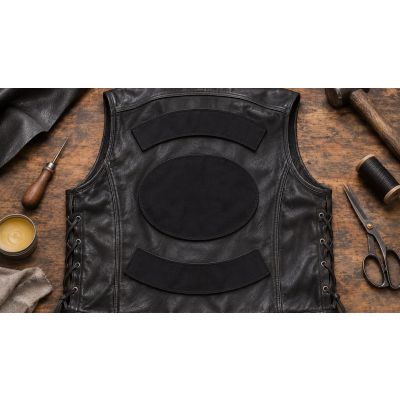
Short answer: most vest layouts use a center patch on the back, a top rocker above it, a bottom rocker below it, and smaller patches and tabs on the front. Meanings vary by region and by group, so if a patch, a rocker or a set of colors belongs to a club or a rank, wear it only if you belong. When in doubt, keep to personal, event and generic patches.
Patch layout explained
The back of a vest is the main canvas. A common arrangement looks like this, from top to bottom:
- Top rocker: a curved patch across the upper back, usually carrying a name or a group name.
- Center patch: the largest patch, in the middle of the back. It carries the main design.
- Bottom rocker: a curved patch under the center, often showing a place or region.
On the front, space is usually smaller: a name or nickname tab on the chest, small tabs, pins and flat patches in the upper chest area, and sometimes a patch near the pocket. Think of the back as the headline and the front as the footnotes.
The diagram for this guide uses placeholder text, so you can see the zones without any real club's design.
What each patch means
Patch meanings are not governed by any single rulebook. They are traditions, and they differ between regions, riding scenes and groups. Treat these definitions as general and check local custom before you stitch anything on.
| Patch | Usually means | Open to anyone? |
|---|---|---|
| Center patch | The main emblem on the back, often a group's design | Only if it is your own design or a generic one |
| Top rocker | A name, often of a group | Own name or neutral text is fine |
| Bottom rocker | A place or territory | Be careful; it can signal a claim to an area |
| Name tab | The wearer's name or nickname | Yes |
| Event pin or patch | A rally, ride or charity event attended | Yes, if you attended |
| Rank or role patch | A role within a group | No; member only |
| Support or affiliation patch | Support for or ties to a group | Think first; it can be read as a statement |
Patches to avoid unless you are a member
Some patches carry meaning that goes beyond decoration. Wearing them without belonging can cause real friction, so it is better to leave them off.
- Club colors, meaning the three-piece set of center patch and rockers that identifies a specific group.
- Rank and role patches, such as officer titles.
- Support and affiliation patches, which can suggest you are part of or allied with a group.
- Territorial rockers that name a region in a way that might be read as a claim.
The reason is simple. For members, these patches are earned and carry obligations. A copy worn for style can look like disrespect. In some places, groups also protect their designs as trademarks, so copying them can raise legal questions as well.
Safe, neutral options
You do not need club patches to make a vest your own. Good choices include:
- Your own name or nickname tab.
- Event pins and patches from rides, rallies and charity runs you attended.
- Brand and manufacturer patches for bikes or gear you use.
- Flags, regional emblems and military service patches if they are yours to wear.
- A custom design of your own, with no resemblance to an existing group.
If you are copying a look from television or film, such as the vest worn in a drama about a fictional club, use generic patches in the same layout. We cover this approach in our Jax Teller vest guide.
Placement tips
- Lay the vest flat and mark the center line with chalk or removable tape.
- Keep the back symmetrical. Center the main patch on the spine and keep rockers the same width as, or slightly narrower than, the patch they frame.
- Leave a margin. Stay several inches away from side seams, the collar and the hem, so patches do not pull on seams or crease at the edges.
- Avoid seams and pockets. Stitching through a seam weakens it. Keep patches fully on one flat panel where you can.
- Allow for movement. Sit on a bike or in a chair with the vest on and check that nothing bunches or lifts.
- Do not overload the front. A crowded chest looks messy and adds weight to the leather. Fewer, well-chosen patches read better.
When it is time to attach them, read how to put patches on a leather vest before you start.
How big should patches be?
There is no standard size, but proportion helps. A back center patch should fill a good share of the shoulder width without running into the armholes, with room around it. Test with a paper template the size of the patch, held in place with tape, before you buy or sew. This avoids the common problem of a patch that looks fine in the picture but is too large for the panel.
Ordering a vest with space for patches
If you plan to patch a vest, choose a plain, flat back panel with no seams, panels or prints where the patch will go. Our men's leather vests range includes plain styles that work well for this, and you should check the product page for panel layout and lining. Leather Collection's workshop will sew on patches you supply, and can also make custom patches to your design. Our guide to leather vest size and fit helps you choose a size that will carry the weight of patches without sagging. For a wider look at the garment, see motorcycle vests explained. Suit riders have their own approach, covered in embroidery, printing and patching on riders' suits.
Planning a layout before you buy patches
The best way to avoid wasted money is to plan the layout on paper first. Draw the vest back to scale, mark the seams and the spine, and cut paper shapes for each patch. Move them around until the balance looks right, then photograph the layout so you can copy it on the vest.
- Start with the largest patch. Everything else is placed around it.
- Keep related patches together. Group event patches on one side rather than scattering them.
- Leave room to grow. Most riders add patches over the years, so a vest that is full on day one has nowhere to go.
- Think about weight. A heavily patched vest is much heavier, and the shoulders carry the load.
Etiquette in a nutshell
- Do not wear patches that belong to a group you are not in.
- Do not wear rank or role patches unless you hold the role.
- Ask if you are unsure. People who care about patches are usually happy to explain.
- Respect local custom, because it varies from place to place.
- Keep your own patches honest: events you attended, places you have been, your own name.
FAQs
Where do patches go on a motorcycle vest?
The main patch goes in the center of the back, with rockers above and below if you use them. Smaller patches, tabs and pins go on the front, spaced with a margin from seams and edges.
What is a center patch?
It is the largest patch, in the middle of the back, and carries the main emblem or design. In group settings it is usually the most significant patch on the vest.
Can I wear a club patch if I am not a member?
It is best not to. Club patches carry meaning for the people who earned them, and wearing one without belonging can cause offense. Use personal or generic patches instead.
What do rockers mean?
Rockers are curved patches above and below the center patch. The top one commonly names a group and the bottom one a place. Meanings vary, so check local custom.
How big should vest patches be?
Size them to the panel and leave a margin. Cut a paper template, tape it on, and check the look and the movement before you stitch.
Looking for a vest to patch? See our men's leather vests.