 USA
 Canada
 Brazil
 Germany
 France
 Italy
 Switzerland
 Sweden
 Spain
 Norway
 Russia
 South Africa
 Japan
 New Zealand
 Australia

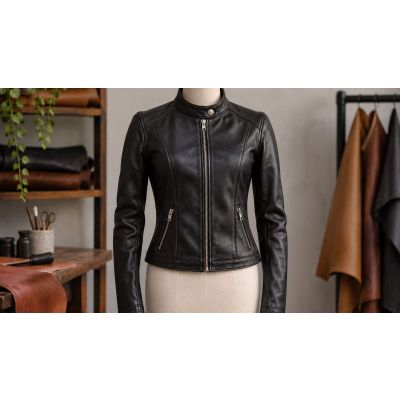
Short answer: petite describes height, not size. A petite frame is shorter, so a standard jacket tends to run long in the body, wide at the shoulder and long in the sleeve, whatever the chest number says. A good fit puts the hem near the hip bone, the shoulder seam at the edge of your shoulder and the cuff at the wrist bone. Made to measure can set all three.
What petite actually means
Petite is a height category. It is not a code for "small". A woman can be petite and wear a US 16, or be tall and wear a US 4. Sizing bodies and tailoring sources define the petite band by height, and the exact cut-off varies by brand and country.
This matters because most women's jacket patterns are built on an average-height body. When you shorten a body, everything that sits between shoulder and hem moves: where the armhole ends, where the waist is, how long the sleeve runs. Scaling a pattern down in width alone does not fix that. You can wear the right chest size and still look like you borrowed the jacket.
Length: where the hem should land
On a shorter torso, the hem sets how long your legs look and how boxy your top half reads. Three lengths work well:
- Cropped, ending at or just above the waist. It shows the most leg and suits high-rise pants and skirts.
- Hip-length, ending near the hip bone. The safest all-round choice and the length most petite wearers find easiest to style.
- Mid-thigh or longer. This can work, but a long hem on a short frame cuts your height visually. It looks best when the jacket is slim and the length is deliberate, as with a coat.
A quick test: stand straight with your arms relaxed. The hem should not pass the widest point of your hips unless you want a long line. If you cannot tell, compare it with the hem of a jacket you like and measure the difference from your nape to the hem. Our guide on short versus long jackets covers how each length changes your proportions.
Shoulders and armholes: the part that gives it away
The shoulder seam should sit on the edge of your shoulder bone, where the shoulder turns into the arm. If the seam hangs down the upper arm, the jacket is too wide for you, and no amount of tailoring in the body will hide it.
Armholes are the second giveaway. If the armhole sits too low on a short frame, the fabric bunches under the arm when you lift it, and the sleeve drags the whole jacket up with it. In leather this is more visible than in cloth, because leather does not drape and relax the way woven fabric does. It folds and holds the fold.
Check three things in the mirror:
- The shoulder seam lines up with the edge of your shoulder.
- You can reach forward, as if you were holding a steering wheel or a bag strap, without the back pulling tight.
- Raising your arms does not lift the whole hem above your waist.
Sleeves: how long and what can be changed
Sleeves should end at the wrist bone, with a slim cuff resting on or just below it. A sleeve that covers the base of the thumb is too long for most jackets; a cuff that rides halfway up the forearm is too short.
Shortening leather sleeves is harder than shortening cloth. The usual alteration shortens at the cuff, but a zip, a zipped cuff or a decorative detail can make that difficult, and old stitch holes stay visible in leather because they do not close up. We do not offer alterations after delivery. If the jacket needs more than a small change, it is often cleaner to have it built to your sleeve length than to alter it afterward.
Styles that work on a petite frame
| Style | Why it works | Watch for |
|---|---|---|
| Cropped biker | Short body length and a defined waist show your proportions | Lapels and pockets should be scaled down, not oversized |
| Bomber | Rib hem and cuffs fix the length for you | Rib cuffs sit too low if the sleeve is long |
| Fitted blazer | A tailored line adds structure without bulk | Shoulder width and button position |
| Short moto | Clean lines, no extra fabric to manage | Zipper pull and belt-buckle scale |
| Oversized or long coat | Can work as a fashion choice | Hem and sleeve length swamp a short frame |
Oversized jackets usually fail on petite frames because the extra fabric adds width where you have the least height to absorb it. If you want a relaxed look, ask for a slightly longer sleeve and a looser body, but keep the shoulder seam and hem where they should be.
Off the rack or made to measure
A standard jacket is graded from a sample pattern. The chest, waist and hip numbers change from size to size, but the body length and sleeve length change much less. That is why "petite" often means a stock jacket with the sleeve trimmed.
When you order custom leather jackets, you can supply your own measurements instead of choosing a size. For a petite frame, the measurements that make the most difference are:
- Back length from the base of the neck to the hem you want.
- Shoulder width, seam to seam.
- Sleeve length from the shoulder point to the wrist.
- Armhole depth or upper arm width if you plan to wear layers.
- Waist position, so a fitted style follows your waist and not a stock waist.
Our guides to measuring yourself for a leather fit and how women's jackets should fit show how to take each number. Have someone else measure you, since the sleeve and back length are hard to take alone. For Custom Size, we send the measurement request after you order, using your order number, and you can add notes in the Order Instructions box.
A ten-second fit check
- Shoulder seam on the edge of the shoulder, not on the arm.
- Hem at the hip bone or where you chose, not passing the widest part of the hip by accident.
- Cuff at the wrist bone.
- Zip closed, with room to breathe and cross your arms.
- No fold of leather under the arm when you raise your arms to shoulder height.
If two of these fail, the issue is the pattern, not the size. That is the time to move from standard sizing to measurements.
Pairing a petite jacket with the rest of your outfit
Match the jacket length to the line below it. A cropped jacket goes with a high-rise waist; a hip-length jacket suits a straight or slim leg; a longer jacket needs a slim bottom so the outline does not become a rectangle. Keep colors close together from top to bottom if you want to look taller: black jacket with dark denim, or a tan jacket with cream. Browse women's leather clothing for styles in these lengths, and check the size chart so your height and chest sit in the right row before you consider adjustments.
FAQs
What does petite mean in jackets?
Petite means the garment is cut for a shorter person, usually through a shorter body length, shorter sleeves and a higher armhole. It is about height, not chest size.
How long should a petite leather jacket be?
For most petite wearers, a hem at the hip bone or slightly above is the easiest length. Cropped works with high-waisted bottoms; longer hems shorten your legs visually unless the cut is slim.
Can I shorten leather sleeves?
Sometimes, but it depends on the cuff, zips and lining. Needle holes in leather do not close, so repeated alterations leave marks. Ask the maker before you buy a jacket you plan to change. We do not offer alterations after delivery.
What styles suit petite women?
Cropped bikers, bombers and fitted blazers tend to suit shorter frames. Oversized and very long styles are harder to wear well.
How do I measure for a petite jacket?
Measure back length from the nape to the hem you want, shoulder width, sleeve length from the shoulder point to the wrist, and chest, waist and hip. Ask a helper to take the measurements and write each one down.
Is petite the same as small?
No. Small is a width size. Petite is a height category. You can need a petite cut in any width.
If standard sizes keep missing on length, shoulder or sleeve, order a made-to-measure leather jacket in your own proportions.