 USA
 Canada
 Brazil
 Germany
 France
 Italy
 Switzerland
 Sweden
 Spain
 Norway
 Russia
 South Africa
 Japan
 New Zealand
 Australia

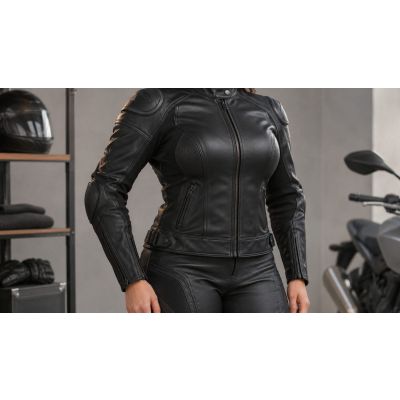
Short answer: armor protects only where it sits over the joint or bone it is meant to cover. On a curvier body, check four things before price or style: where the elbow and knee armor land when you are seated, whether the jacket closes without strain, whether there is a gap at the waist, and whether the pants have room at the hip and thigh. Gear made to your measurements lets you set these instead of hoping a standard size lands right.
Why fit matters for safety
Armor is shaped to cover a particular area: the point of the elbow, the shoulder cap, the kneecap, the spine. In a crash, the jacket or pants can slide and rotate on your body. If the armor already sits an inch off its mark when you are standing still, it can end up further away when the garment moves.
The CE standards for protectors, EN 1621 for impact protectors and EN 17092 for riding garments, test the protectors and the garment, but they cannot test how a size sits on your particular body. For that reason, fit is part of the protection. Read the standards summaries rather than relying on a shop's wording, and ask the maker what level of protection each piece has.
Fit also affects how well you ride. A jacket that binds across the bust or back, or pants that cut into the thigh when you bend your knee, will distract you and tire you out. This is a guide to choosing gear that stays where it should, with no assumptions about what size anyone should be.
Jacket fit: bust, upper arm, shoulder and zip
For women's jackets, three numbers decide most of the fit: bust, upper arm and shoulder width. Take the measurement at the fullest part of the bust, around the upper arm at its widest point, and across the shoulders from seam to seam.
Then check these points on the jacket:
- Zip closure under strain. Sit in your riding position with your arms forward. The zip should close without pulling the leather into folds, and the front panels should not gape.
- Upper arm. You should be able to bend your arm fully without the sleeve cutting across the bicep or the elbow armor sliding toward the forearm.
- Shoulder seam. It should sit on the shoulder edge and the shoulder armor over the cap of the shoulder, not toward the neck or down the arm.
- Back length. Leather rides up when you lean forward. A jacket that covers the lower back while you are seated protects more than one that stops at the waist.
Our guide to how women's leather jackets should fit goes through each measurement, and the fashion versus protection article explains what separates a riding jacket from a fashion piece.
Pants fit: hip, thigh, rise and knee armor
For pants, size by hip first, then thigh and rise. Most fit problems come from a waist that fits but a hip or thigh that does not, or the reverse.
- Hip and thigh. You should be able to sit on the bike with your knees bent, not just stand in them. If the leather pulls tight across the thigh in the seated position, it will get tighter as you ride.
- Rise. A low rise on a curvier body can gap at the back when you lean forward. A higher rise covers the lower back and stays put.
- Knee armor. With your knee bent as if on the pegs, the armor should be centered over the kneecap. If it slides down toward the shin, the pants are too long, or the knee pocket is set too low for your leg. Our article on where armor sits in a race suit shows the target positions.
Pants made to measure give you control of waist, hip, thigh and inseam separately. See custom motorcycle pants for how the order works.
Waist gap and seat room
A waist gap is the open space between the garment and your body at the small of the back or sides. In women's cuts it usually appears when the garment is graded up in size by adding width evenly, so the waist is wider than the person.
A gap lets armor and leather shift. It also means wind or rain can get in. To close it:
- Give the maker your actual waist measurement, not the size that matches your bust or hip.
- Look for adjusters at the waist or hem, such as snaps, buckles or lacing, if you ride at varying weights or with layers. Check the product page for the closures a style has.
- Check the fit seated, because a garment that fits standing may bunch at the front or gape at the back.
Seat room is the opposite problem: a seat or hip seam that is too tight restricts movement. Sit on the bike or a similar-height chair with your knees apart and your hands forward, and check that no seam bites into you.
Armor on curvier bodies
| Armor | Where it should sit | Typical fit problem | What to ask for |
|---|---|---|---|
| Shoulder | Over the point of the shoulder | Sits too far in if the jacket is too narrow, or off the arm if too wide | Shoulder width, seam to seam |
| Elbow | Over the point of the elbow with the arm bent | Slides toward the wrist if the sleeve is long | Sleeve length and upper arm width |
| Back | Along the spine, from the base of the neck down | Too short or sits high on a longer torso | Back length |
| Hip | Over the side of the hip, if fitted | Off the hip bone on a wider hip | Hip measurement and pocket position |
| Knee | Over the kneecap with the knee bent | Slides down on longer pants or a long thigh | Inseam and knee position |
A bigger size does not mean thicker armor. Protection level comes from the armor's certification, not from the size of the garment Our jackets have removable CE Level 1 armor at the shoulders and elbows, with Level 2 as a paid upgrade, and our riding pants have removable CE Level 1 knee and hip armor. Ask the maker what protector is fitted and what level it carries.
Made-to-measure options
A made-to-measure order replaces a size label with your numbers. For custom motorcycle jackets, the Custom Size form asks for neck, chest, waist, hips, sleeve, shoulder width and back length. For pants it asks for inseam, outseam, thigh, knee and calf. It also asks for height, weight and front and side photos.
Take each measurement over thin clothing or on bare skin, with a flexible tape held level and snug but not tight, and have someone else take them. Write every number down. Our guide to measuring yourself shows the positions, and the size chart is the reference if you choose a standard size. Our women's gear is cut from women-specific patterns with bust, waist and hip shaping, and Custom Size covers anything else.
Questions to ask any maker
- What armor is in each position, and what standard does it meet?
- Can the armor position be set to my measurements?
- What is the largest bust, waist and hip you can make this style for?
- Can the sleeve, body or inseam length be changed?
- Is there stretch or an adjuster at the waist, and where?
- What happens if the garment does not fit when it arrives?
A maker who answers these clearly is easier to trust than one who answers with a size chart. For us: if sizing or workmanship is our error, we remake the item free and pay shipping both ways. Custom-made items cannot be returned.
A fit checklist you can use today
- Sit in a riding position with your arms forward and check the jacket closes and the back stays covered.
- Bend your knees and elbows. The armor should stay centered over each joint.
- Look for waist gaps at the side and back.
- Check the pants for pulling at the thigh and seat.
- Lift your arms. The hem should not ride up to expose your lower back.
- Confirm the armor level with the maker, not with a size label.
FAQs
Is plus-size motorcycle gear available?
Yes, from several makers, though range and cut vary. Ask for the actual measurements each size covers, not just the label. Our women's gear is cut from women-specific patterns, and Custom Size covers anything else.
How do I know armor is in the right place?
Sit in your riding position and bend your arms and knees. The elbow armor should be over the point of the elbow and the knee armor centered on the kneecap. If it moves toward the wrist or shin, the garment is too long or the armor pocket is set wrong for you.
Can I have a jacket made to my measurements?
Yes. See custom motorcycle jackets. Provide bust, waist, hip, shoulder, upper arm, sleeve and back length.
What pants fit wide hips?
Choose pants sized on hip and thigh first, then adjust waist and length. A higher rise often sits better. Made-to-measure pants let you set each measurement separately.
Is a custom suit worth it?
If standard sizes fail on more than one measurement, a custom suit can be the better value because it fits properly from the start. Compare it against the cost of buying and altering gear that never fits.
Does a bigger size mean thicker armor?
No. Armor level comes from the protector's certification and is independent of size. Ask the maker to confirm the protector and level for each position.
If standard sizes keep missing, order custom motorcycle jackets and custom motorcycle pants built from your own measurements.