 USA
USA  Canada
  Brazil
  Germany
  France
  Italy
Italy  Switzerland
  Sweden
  Spain
Spain  Norway
  Russia
  South Africa
  Japan
Japan  New Zealand
  Australia
A women's military-style leather jacket is a jacket that borrows structure from uniform and field clothing: a defined shoulder line, a collar that stands or folds flat, buttoned or zipped pockets and a hem that sits at the hip. To choose one, start with the cut that matches how it will be worn, then check the shoulder fit, sleeve length and the leather's weight. Colour and hardware come last, because they change the mood far more than the shape.
The look draws on several different garments, so "army style" can mean quite different jackets. This guide separates the main cuts, explains what to check in the fit, and shows how to style each one with everyday clothes.
Key Takeaways
- Military style is a set of details (structure, pockets, collar), not a single jacket; pick the cut first.
- Shoulder fit decides whether a structured jacket looks sharp or borrowed, so check it before sleeve length.
- Olive, black and brown keep the look uniform-inspired; lighter shades soften it.
- Keep the rest of the outfit simple, because the jacket already carries the detail.
What Makes a Jacket Military-Style
Three source garments account for most of what shoppers call military style. The first is the flight jacket. The US Army Air Corps adopted the Type A-2 flight jacket as standard issue on 9 May 1931, and it was originally made from chrome-tanned horsehide, with a shirt-style collar and a front zipper. That helped make leather part of the flight-jacket tradition.
The second is the field jacket. The M-1965 field jacket was introduced in 1965 in a cotton-based fabric with two large hip pockets and two breast pockets, and a hood stored in the collar. Civilians have worn versions of it since at least the early 1970s, and four pockets with a utility look are a common field-jacket detail.
The third is naval clothing. The pea coat is short, double-breasted and has broad lapels and large buttons arranged in two rows. Leather versions borrow that front and the wide collar, which gives a more formal outline than a flight jacket.
Across all three, the recurring details are shoulder straps (epaulettes), flap pockets, a throat latch or buttoned collar, and a clean, restrained line. A jacket with two or three of these reads as military-inspired; a jacket with all of them reads as a direct reference.
The Main Cuts to Compare
Flight-jacket cut
Short, close to the hip, with a snug waist and often a plain collar. It suits high-waisted trousers and skirts because it ends where the waistband begins. People with a shorter torso tend to find this the easiest cut to wear.
Field-jacket cut
Longer, boxier, with patch or flap pockets and sometimes a drawcord at the waist. It gives more room for layers and works as a light coat. A drawcord or belt helps if the straight body looks too wide on a narrow frame.
Double-breasted and officer-style cut
Two rows of buttons, broad lapels and a tailored shoulder. It is the most formal of the three and pairs well with trousers and boots. It needs the most accurate fit, since the front panels overlap and any pulling shows at the buttons.
Where biker and cafe racer styles overlap
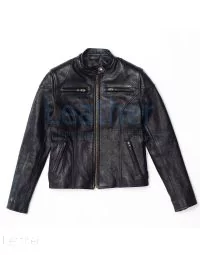
A minimal collar and a short body place cafe racer jackets close to flight-jacket shapes. A style such as the is an example of a short cafe racer cut that sits in this territory without uniform detail. Biker jackets with a wider, asymmetric front are a separate category, though some shoppers cross-shop them with military cuts because both are structured and short.
| Cut | Typical length | Key details | Pairs with |
|---|---|---|---|
| Flight-jacket cut | At the waist or hip | Close body, plain or shirt-style collar, front zip | High-waisted trousers, skirts, dresses |
| Field-jacket cut | Hip to mid-thigh | Four pockets, straps, optional drawcord | Jeans, knitwear, layers |
| Double-breasted cut | Hip | Two button rows, broad lapels | Trousers, boots, simple tops |
Fit and Leather: What to Check
Structured jackets show fit problems quickly, so work through the same checks every time.
- Shoulders. The seam should land at the edge of the shoulder bone. If it sits further out, the jacket looks oversized and the sleeves hang too low.
- Sleeves. With the arms relaxed, the cuff should end around the wrist bone. Leather does not stretch evenly, so sleeves that are too long are hard to correct later.
- Chest and waist. Zip or button the jacket over the clothes that will be worn under it. Pulling across the chest or at the buttons means the next size up or a made-to-measure option.
- Length. The hem should meet the waistband of high-waisted bottoms or sit just over the hip for a straight-leg trouser.
Leather weight changes the shape as well. Softer, thinner skins drape and wrinkle easily and suit a relaxed, wearable shape. Thicker hides hold a structured outline and take longer to soften. Ask the maker which skin is used and how it behaves, because descriptions vary between products. A sizing page or measuring guide helps, and the product pages linked here list a made-to-measure Custom Size option in the order form.
Colour and Hardware
Olive, black, dark brown and tan are the usual choices for a uniform-inspired look. Black reads sharpest and works with most wardrobes. Olive and brown lean toward the field-jacket reference and combine well with cream, denim and grey. Tan and lighter shades soften the effect, which can help when the cut itself is strict.
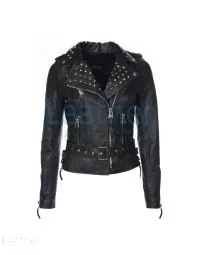
Hardware sets the tone. Matte brass or dark metal buttons feel closer to uniform clothing, while bright chrome zips look more modern. Studs or fringe move a jacket away from military style toward a rock or western look. A design such as the is described on its product page with a studded collar, shoulder epaulettes and an adjustable waist belt, which shows how added metalwork changes the character of a jacket.
How to Wear a Military-Style Leather Jacket
The simplest approach is to let the jacket supply the detail and keep everything else plain. A white or striped tee, straight jeans and boots is a reliable base. Swap jeans for tailored trousers and the same jacket moves toward smart casual.
For a softer contrast, wear a short flight-style jacket over a midi skirt or a slip dress, with boots or flat shoes. The structured shoulder balances the fluid fabric. Browse the range for companion pieces in matching leather.
Layering works well with field cuts: a knit or a hoodie underneath fills out the roomy body, and a scarf fits inside a standing collar. Add simple accessories such as in the same colour family, and avoid mixing too many leather finishes at once. Choosing one dominant colour and one metal tone keeps the outfit cohesive.
A vintage-style silhouette is another direction, and the is an example, described on its product page as nappa sheepskin with a plain finish that preserves the leather's natural character. Quilted panels add texture, and a shows a different route from the plain, smooth surface that classic military cuts use.
Care and Buying Notes
Follow the care label and the maker's instructions for the specific garment, since the right product depends on the leather's finish and construction. Hang the jacket on a wide, shaped hanger so the shoulders keep their outline, and if the jacket gets damp, check the care label and the maker's instructions for drying.
Before buying, compare the sizing chart with a jacket that already fits well, check the lining and pocket depth, and read the product description for the leather type. If the jacket is for motorcycle riding and not for fashion use, a fashion jacket is not the same as protective riding gear; ask the seller about armour and documentation; the women's jackets linked in this guide list no armour on their product pages.
Choosing Between Cuts
If the choice is between a flight cut and a field cut, consider the existing wardrobe. Mostly high-waisted bottoms favour the flight cut. Mostly jeans and layers favour the field cut. Many shoppers keep one short and one long jacket in the same colour for different outfits.
Frequently Asked Questions
What is a military-style leather jacket?
It is a leather jacket that borrows details from uniform and field clothing, such as shoulder straps, flap pockets, a standing or shirt-style collar and a structured shoulder. The inspiration usually comes from flight jackets, field jackets or naval coats. It is a styling reference, so no particular jacket has to match an actual military pattern.
Which colour suits a military-style jacket?
Black, olive, dark brown and tan are the usual picks. Black gives the sharpest outline and fits most wardrobes. Olive and brown lean toward the field-jacket look. Tan softens a strict cut. Choose by the clothes already owned: the jacket should work with at least three outfits before buying.
How should a structured leather jacket fit?
The shoulder seam should sit at the edge of the shoulder, the cuffs should end near the wrist bone and the front should close without pulling over the clothes worn underneath. Leather stretches unevenly, so a snug but comfortable fit is safer than a tight one. Compare the size chart with a jacket that fits well.
Can a fashion jacket be used for motorcycle riding?
A fashion jacket is not riding gear by default. Protective clothing is made and documented for riding, and standards such as EN 17092 apply to the garments that claim them. Ask the seller for the documentation, check what the product page lists about armour, and do not assume a styled jacket offers protection.
Written by the Leather Collection Editorial Team.